 2-5 day delivery
 100.000+ satisfied customers
 Satisfaction Guarantee








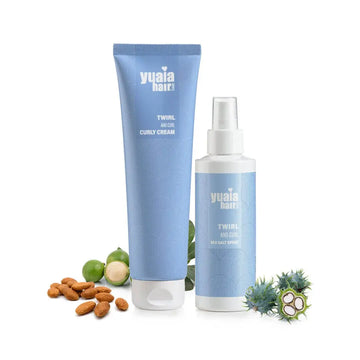





2C hair: Strong waves and occasional loose curls
2C hair has a more pronounced wave pattern than 2B, sometimes beginning closer to the roots. Some sections may curl, while others remain S-shaped. A stronger wave does not automatically mean thicker strands or greater hair density.
Detangle gently with conditioner if needed, then apply styling product evenly. Gel can help the waves keep their shape; add a little leave-in or cream if the lengths feel dry. Let hair dry with minimal handling, or use a diffuser on low heat and low airflow.
3A hair: Loose spiral curls
3A hair forms recognisable, relatively loose spirals rather than mainly flat S-shaped waves. Waves near the roots or looser sections do not rule out this pattern. Assess several sections after drying rather than comparing a single curl with the diameter of a pencil or a piece of chalk.
Use enough conditioner to make detangling comfortable, rinse as directed and apply styling product in sections. A little curl cream can add softness; gel can add hold. Fine 3A hair may need very little cream. If definition disappears during the day, adjust hold or drying technique rather than assuming the hair needs more oil.
3B hair: Tighter, springy spirals
3B curls are generally tighter than 3A curls and may look shorter when dry because they spring back. The pattern alone does not tell you whether the strands are fine or coarse, or whether the hair needs a rich treatment.
Work in smaller sections so conditioner and styling product reach the lengths evenly. Detangle from the ends upwards without pulling. Choose conditioning by softness and manageability, and choose hold by how well the curls keep their shape. Richer cream may suit some hair, while other 3B curls respond better to a lighter routine.

2C vs 3A: Waves or spirals?
The main distinction is shape: 2C is predominantly wavy, while 3A forms loose spirals. Both can occur together. You do not need one perfect label to build a useful routine; assess whether the hair needs more softness, more hold or less product.
Care and styling for your actual hair
Curl pattern is only one clue. Strand thickness, density, porosity, colour treatment and the condition of your scalp also influence your routine. Wash when your scalp and product buildup require it; a curl type cannot set a universal washing schedule.
Dry gently with a soft towel or cotton T-shirt rather than rubbing. If a gel forms a firm cast, wait until the hair is completely dry before gently scrunching it out. Between washes, try a little water on the sections that need reshaping before adding more styling product.
Choose cream or gel by the result you want
For help with softness and application, read our curl cream guide. For a comparison of conditioning and hold, see curl cream vs gel. You can also browse the Twirl and Curl range and check each product’s directions before adding it to your routine.

Frequently asked questions about curl types
Can I have both 2B and 3A hair?
Yes. Mixed patterns are common. Use the descriptions as a guide and adjust styling by section if the front and back respond differently.
Is 2C hair always thick?
No. Curl pattern describes shape, not strand thickness or the number of hairs on your head. 2C hair can have fine, medium or coarse strands.
How do I tell 2C hair from 3A hair?
Look at fully dry hair: mainly S-shaped waves suggest 2C, while loose spiral curls suggest 3A. A combination is possible.
Do all curl types need oil or heavy cream?
No. Start with a small amount of product and adjust to dryness, softness and hold. If hair feels coated or limp, simplify the routine.
Can products change my curl type?
Products can enhance definition or weigh down the pattern, but they do not permanently turn waves into a different natural curl type.


